


 English
 中文简体
中文简体1. Material Selection and Weather Resistance in Outdoor Furniture Choosing the right material is the...
READ MOREEnergy Storage Systems Cooling: Liquid, Air, and Immersion Compared for BESS
Author: Admin
Date: Oct 12,2026
A 5 MWh battery container that runs just a few degrees above its target cell temperature can age faster, trigger conservative power limits, and increase fire risk. Cooling is not a peripheral accessory in energy storage systems; it is one of the primary determinants of usable capacity, round-trip efficiency, maintenance cost, and project insurability. The practical conclusion is straightforward: air cooling still works for smaller, lower-density systems, but liquid cooling has become the default for containerized utility-scale storage, while immersion and hybrid approaches fit niche high-density or retrofit cases.
Content
- 1 Why Cooling Defines BESS Performance and Risk
- 2 Air Cooling: Simple but Limited
- 3 Liquid Cooling: Cold Plates and Direct Contact
- 4 Immersion and Hybrid Cooling: Where They Fit
- 5 Thermal Runaway, Safety, and Enclosure Design
- 6 Design, Controls, and Monitoring
- 7 Matching Cooling to Project Conditions
- 8 Manufacturing and Lifecycle Considerations
Why Cooling Defines BESS Performance and Risk
Battery cells generate heat during charging and discharging. Heat is not uniform: cells near the center of a module or rack usually run hotter than cells near the container wall. Temperature spread matters as much as average temperature. A 5°C spread across a rack can cause imbalance, faster capacity fade, and inaccurate state-of-charge estimation. Over years, the hottest cells degrade first, and the system’s usable capacity is limited by its weakest cells.
Thermal runaway is the safety concern. Once a cell reaches its onset temperature, exothermic reactions can propagate to neighbors. Cooling design, venting, and fire suppression must work together. Standards such as UL 9540A and NFPA 855 are not cooling specifications, but they influence how engineers document propagation resistance and module spacing. A cooling system that only handles normal operation but cannot support emergency thermal management may fail regulatory review.
Air Cooling: Simple but Limited
Air cooling uses fans to move air across modules, racks, or containers. Natural convection is the simplest form, but forced convection is more common in BESS. Strengths include low initial cost, familiar maintenance, no coolant leaks, and easy visual inspection. It suits smaller commercial systems, lower C-rate applications, and moderate climates where ambient temperatures stay within a defined range.
Limits are equally clear. Air has low heat capacity and poor thermal conductivity. It struggles to keep large-format cells within tight temperature tolerances at high power. Fan energy can be significant, and filters need regular replacement. In dusty or humid sites, air cooling can draw in contaminants and moisture. For 5 MWh containers and high-density racks, air cooling often requires oversized airflow paths, which reduces energy density and increases auxiliary load.
| Method | Best fit | Thermal control | Maintenance |
|---|---|---|---|
| Air cooling | Small C&I, low density, mild climate | Moderate; larger temperature spread | Simple; filters and fans |
| Liquid cold plate | Utility-scale containers, high density | Strong; tight cell uniformity | Moderate; coolant and leak checks |
| Immersion | Very high density, fast charging, space constraints | Very strong; uniform bath temperature | Complex; fluid and compatibility management |
| Hybrid / PCM | Transient peaks, wide ambient swings | Good with tuned controls | Moderate to complex |
Where air cooling still makes sense
- Small commercial and industrial systems with low duty cycles.
- Projects with generous spacing and low ambient temperatures.
- Retrofits where plumbing and leak detection are impractical.
Liquid Cooling: Cold Plates and Direct Contact
Liquid cooling moves heat through a coolant, usually a water-glycol mixture, via cold plates, hoses, and a chiller or heat exchanger. It handles higher heat flux and maintains tighter temperature uniformity than air. In a typical cold-plate design, coolant channels sit under or between modules; a central cooling distribution unit controls flow and temperature. Because liquid carries far more heat per unit volume than air, engineers can pack more cells into the same footprint.
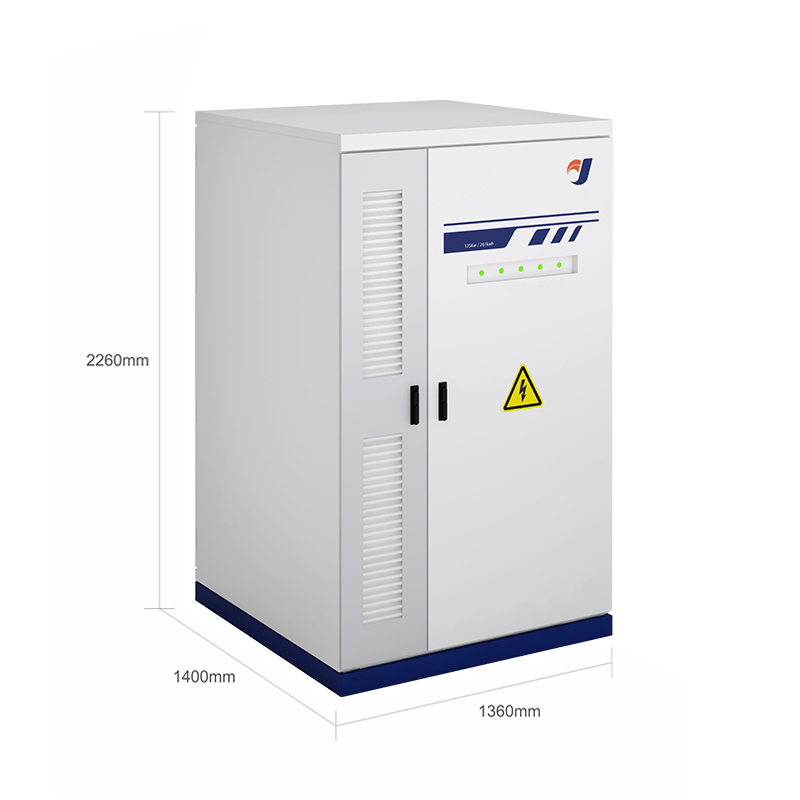 Liquid Cooling 125 kW Energy Storage CabinetA 125 kW, 261 kWh liquid-cooled battery cabinet in a steel enclosure for commercial, industrial, and grid-support applications.View Product →
The trade-off is complexity. Pumps, valves, sensors, and quick-connectors introduce leak risk. Coolant quality must be managed to prevent corrosion, scaling, and biological growth. Service procedures require training. Still, for utility-scale BESS, liquid cooling has become the dominant choice because it supports higher energy density, lower auxiliary power, and longer cell life.
Direct vs indirect liquid cooling
Indirect liquid cooling keeps coolant away from cells. Cold plates or jackets transfer heat through a solid interface. Direct liquid cooling immerses cells or modules in a dielectric fluid or sprays fluid directly onto components. Indirect systems are easier to service and more common. Direct systems can achieve better heat removal but require compatible materials and fluid management.
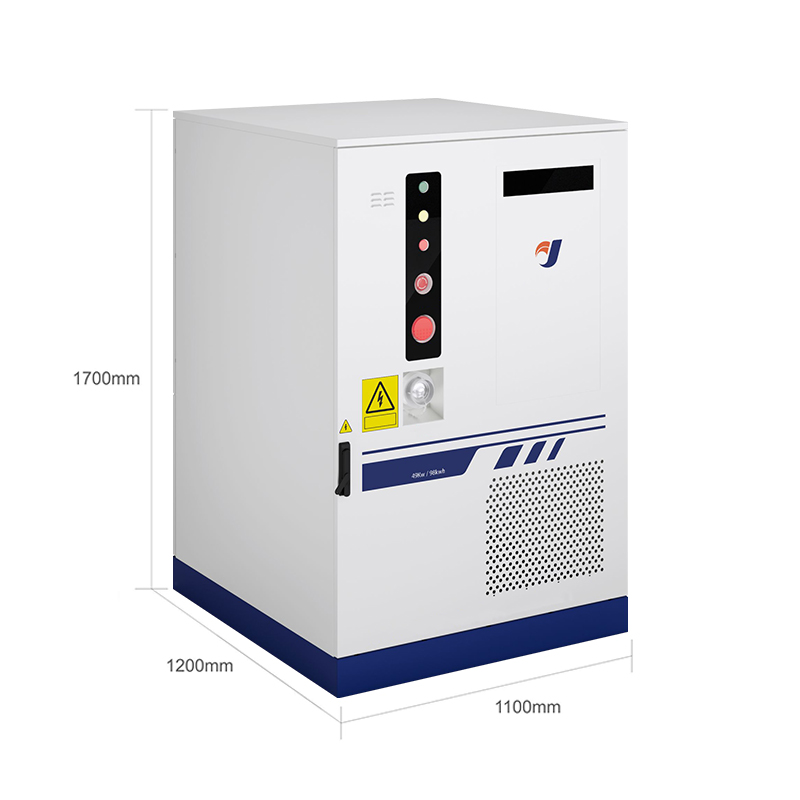 Liquid Cooling 49 kW Energy Storage CabinetA compact 49 kW, 98 kWh liquid-cooled cabinet integrating batteries, power conversion, and monitoring for space-constrained commercial and industrial sites.View Product →
Immersion and Hybrid Cooling: Where They Fit
Immersion cooling submerges modules in dielectric fluid. Single-phase immersion relies on natural or forced convection; two-phase immersion uses boiling and condensation for very high heat flux. Benefits include uniform temperatures, reduced fan energy, and potential fire suppression. Challenges include fluid cost, fluid maintenance, material compatibility, weight, and service access. Immersion is attractive for high-density, high-C-rate applications, but it is rarely the lowest-cost option for standard containerized storage.
Hybrid cooling combines air and liquid, or liquid and phase-change materials. PCM can buffer transient heat loads without immediate chiller demand. A hybrid design may use air for low-load periods and liquid for fast charging or peak discharge. These systems can be effective in climates with wide temperature swings, but control logic becomes more complex and must avoid fighting itself.
Thermal Runaway, Safety, and Enclosure Design
Cooling hardware sits inside an enclosure that must also manage pressure, venting, and fire risk. Sheet metal design matters: airflow paths, coolant routing, service clearances, and gasket selection all affect thermal performance and safety. Condensation is a common failure mode in humid sites. If cold surfaces drop below dew point, water can collect near electronics and terminals. Enclosure designers use insulation, heaters, and humidity control to reduce that risk.
For storage cabinets and containers, IP ratings and corrosion protection are practical purchase criteria. Coastal or industrial sites need coatings and hardware that resist salt and chemicals. Maintenance teams also need front access to filters, pumps, and manifolds without moving battery modules. A cooling system that is efficient on paper but difficult to service will lose uptime in the field. Jiangnan Outdoor’s energy storage cabinets illustrate how enclosure design, coolant routing, and service access are treated as one system rather than separate purchases.
Design, Controls, and Monitoring
Cooling design starts with a heat load calculation. Engineers estimate cell heat generation from charge/discharge profile, internal resistance, and ambient conditions. They then size the cold plate, coolant flow, and chiller capacity with margin. A common mistake is sizing for average load and ignoring peak summer conditions or fast-charge events. Another is ignoring degradation: as cells age, internal resistance rises, and heat generation increases.
Controls and monitoring turn a cooling system into a managed asset. Key measurements include inlet and outlet coolant temperature, flow rate, pressure drop, cell or module temperature, and ambient humidity. Alarms should distinguish a slow trend from a sudden fault. Leak detection should trigger at the lowest point of the enclosure. Redundant pumps or fans may be justified for critical sites, but redundancy adds cost and maintenance. Setpoints should be tuned to avoid short cycling and condensation.
Maintenance checklist for liquid-cooled BESS
- Check coolant level, concentration, and pH at scheduled intervals.
- Inspect hoses, fittings, and quick-connectors for weeping or staining.
- Verify pump and fan operation under load, not only at idle.
- Clean heat exchangers and filters according to site dust conditions.
- Test leak sensors and emergency shutdown logic.
- Record temperature spread across racks to detect degradation early.
Matching Cooling to Project Conditions
Selection is a trade study, not a slogan. Air cooling can be adequate for a 100 kW commercial system in a mild climate with low cycling. Liquid cooling is usually the better fit for 1 MWh to 5 MWh containers, high ambient temperatures, and daily cycling. Immersion may be justified for high-density racks, extreme fast charging, or sites where floor space is very expensive. Hybrid and PCM options can help where peak loads are short but intense.
Consider these criteria:
- Climate: design ambient temperature, humidity, dust, and altitude.
- Duty cycle: continuous, daily cycling, or fast-charge peaks.
- Density: rack spacing, container size, and energy per square meter.
- Service model: local technicians, spare parts, and remote diagnostics.
- Regulatory path: fire code, propagation testing, and insurance requirements.
- Lifecycle cost: initial capex, auxiliary power, coolant, and maintenance.
For wind-integrated or remote projects, cooling must tolerate wide temperature swings and limited maintenance visits. A wind energy storage system may need robust enclosure sealing, wide-temperature coolant, and remote monitoring.
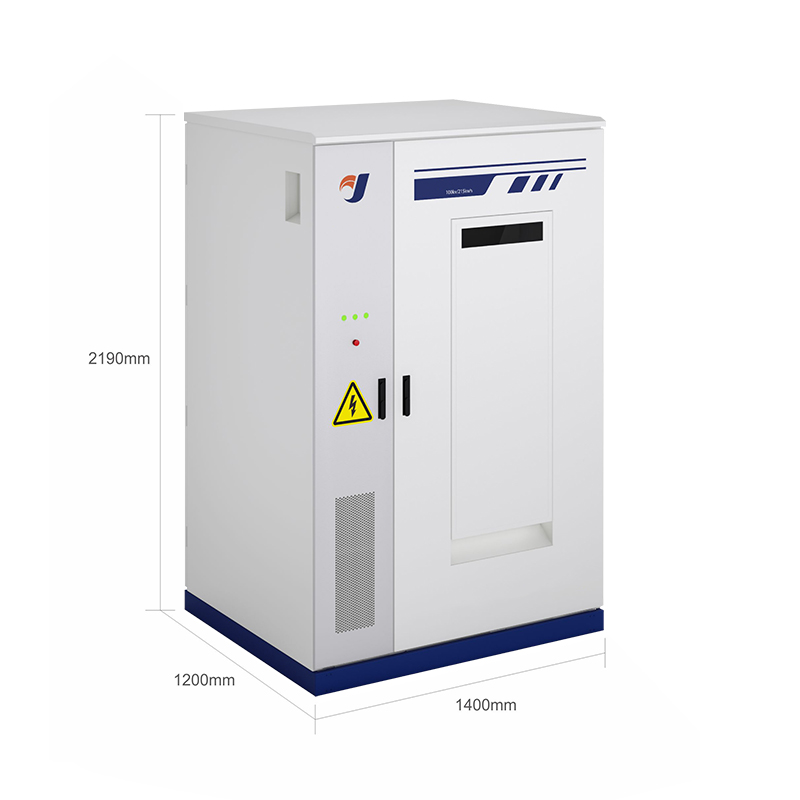 Air Cooling 100 kW Wind Energy Storage CabinetA 100 kW, 215 kWh air-cooled steel cabinet using lithium-ion batteries to support wind power smoothing, off-grid, and hybrid renewable operations.View Product →
Manufacturing and Lifecycle Considerations
Cooling performance depends on the enclosure as much as the chiller. Sheet metal tolerances affect airflow, coolant routing, and structural rigidity. A poorly aligned cold plate or a warped door can create hot spots or leaks. Manufacturers with in-house laser cutting, robotic welding, and automated coating can control those tolerances and repeat them across production runs.
Lifecycle support matters too. Coolant formulations change, pumps wear out, and sensors drift. A supplier that documents torque values, leak-test procedures, and spare-part numbers reduces downtime. Environmental performance is increasingly part of procurement: lower auxiliary power, recyclable metal enclosures, and responsible coating processes all count. Jiangnan Outdoor’s Jiaxing Green Factory recognition and ISO 14001 practices reflect that broader trend, though the cooling system itself still has to perform.
The best cooling strategy is the one that keeps cell temperatures uniform, survives the site’s worst ambient conditions, and can be maintained by the people who actually operate the plant. Air cooling remains a reasonable choice for smaller, low-density systems. Liquid cooling is the practical default for containerized utility-scale storage. Immersion and hybrid designs have clear niches, but they demand more engineering discipline. Start with the heat load, the climate, and the service model, and the cooling decision becomes much less abstract.

Contact Us Now
News
LET’S BUILD YOUR CUSTOMIZED PRODUCT

Copyright ©Zhejiang Jiangnan Outdoor Products Co., Ltd.All rights reserved.
