


 English
 中文简体
1. Material Selection and Weather Resistance in Outdoor Furniture Choosing the right material is the...
READ MOREIndustrial Power Storage: Sizing, Cooling and Enclosure Choices That Last
Author: Admin
Date: Oct 20,2026
Two industrial power storage cabinets can carry identical battery modules and still be separated by a year of service trouble. The gap usually sits in the sheet metal: wall thickness, weld quality, coating thickness, and how the thermal loop is routed inside the frame. When a plant installs a 100 kW or 125 kW system behind the meter, the cells set the performance ceiling, but the enclosure sets the reliability floor. It is the part of the specification buyers review last, and the part that decides whether the system still delivers full power in its third summer.
Content
- 1 What Industrial Power Storage Actually Does Behind the Meter
- 2 Why the Enclosure Specification Decides Long-Term Reliability
- 3 Matching System Class to the Load Profile
- 4 Liquid Cooling: Where It Pays and Where It Is Overkill
- 5 Wind and Hybrid Sites Are the Hardest Duty Cycle
- 6 Site Conditions Buyers Underestimate
- 7 What to Ask a Sheet Metal Manufacturer Before You Commit
- 8 Custom Cabinets Versus Standard Enclosures
- 9 Cost, Lead Time and the Ordering Sequence
What Industrial Power Storage Actually Does Behind the Meter
Industrial power storage is capital equipment with a control strategy attached, not a battery purchase. The hardware matters far less than the duty cycle it is asked to run. Most behind-the-meter projects fall into four jobs:
- Demand charge management. The battery discharges for 15 to 60 minutes during the billing peak; the tariff's kW charge creates the return, not the kWh throughput.
- Backup and ride-through. The system carries critical loads through short outages and voltage sags, so transfer time matters as much as capacity.
- Solar shifting. PV output is stored at midday and discharged into the evening time-of-use peak.
- Grid services. Frequency response and capacity programs pay for fast, shallow cycling rather than deep discharge.
The practical conclusion: define the job before choosing the capacity. A 49 kW cabinet sized for a 40-minute peak shave is a different machine from a 125 kW unit expected to run 300 cycles a year at 80 percent depth of discharge. Both are sold under the same "industrial power storage" label, and the difference only becomes visible once the load profile is mapped.
Why the Enclosure Specification Decides Long-Term Reliability
In field service reports, doors that no longer seal, condensation on busbars and coating that blisters after two rainy seasons appear far more often than cell failures. Those are fabrication outcomes, decided at the drawing stage. Points worth writing into the purchase order:
- Steel type and gauge. Cold-rolled steel at 1.5 to 2.0 mm for structural panels; galvanized sheet where humidity or coastal air is expected.
- Coating. Powder coat measured at 60 to 80 micrometres, supported by a salt-spray test result rather than a marketing claim.
- Ingress protection. IP54 or IP55 for outdoor cabinets, with gaskets on doors, filtered vents and cable entries through proper glands rather than cut slots.
- Compartmentalisation. Separate bays for power conversion, battery modules and controls, so a fault in one does not compromise the others.
- Service access. Door swing, hinge direction and removable panels sized for a technician with a torque wrench.
A supplier that fabricates its own cabinets controls these variables in-house, from laser cutting and robotic welding to the coating line. Buyers who source the energy storage cabinet range from the same factory that forms the steel tend to get straight answers about tolerances, because the tolerance is set on that factory's own equipment.
Matching System Class to the Load Profile
Power class is the fastest way to narrow the shortlist. The three configurations below cover most commercial and light industrial sites, and each has a different bottleneck during commissioning.
| Configuration | Typical pairing | Thermal approach | Verify before ordering |
|---|---|---|---|
| 49 kW liquid-cooled cabinet | Small factories and commercial buildings, 1-2 hour peak shaving | Sealed liquid loop with cold plates | Coolant fill and pressure test records, leak detection, ambient rating |
| 125 kW liquid-cooled cabinet | Industrial plants, larger commercial sites, PV shifting | Higher flow liquid loop with redundant circulation | Point floor loading, rigging access, derating curve above 40 degrees C |
| 100 kW wind-tied storage | Wind farms and hybrid microgrids, output smoothing | Liquid or hybrid design, depending on duty cycle | Ramp-rate control logic, grid-code compliance, corrosion class of the site |
Rated power alone says nothing about how long the system can hold that output. Ask for the discharge curve at the site's expected ambient temperature, not the datasheet figure measured at 25 degrees C.
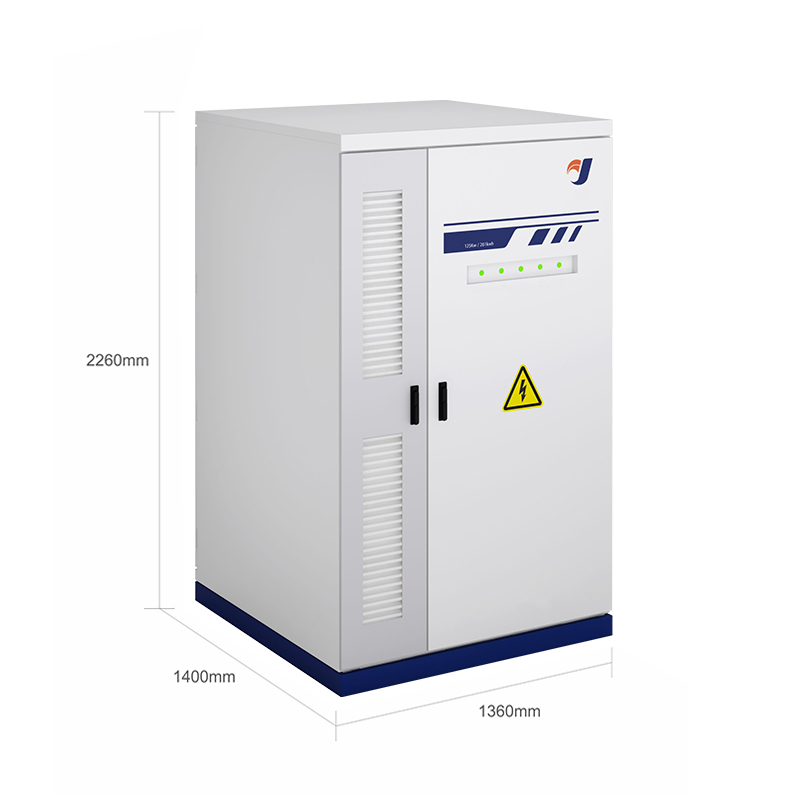 Liquid Cooling 125 kW Energy Storage CabinetWith 261 kWh capacity and liquid thermal management, this cabinet is worth reviewing where high cycling or warm, dusty conditions make air cooling less reliable.View Product →
Liquid Cooling: Where It Pays and Where It Is Overkill
Air cooling remains adequate for lower power density cabinets in temperate, clean environments. It stops being adequate when the site is dusty, when ambient temperature regularly exceeds 35 degrees C, or when the cabinet is cycled heavily every day. Liquid cooling keeps the spread between the hottest and coolest cells within a few degrees, which slows capacity fade and prevents the battery management system from derating early.
The trade-off is maintenance. A liquid loop adds coolant quality checks, pump inspection and connections that must be leak-tested at the factory rather than on site. When the enclosure arrives pressure-tested, commissioning is mostly a matter of verifying flow and topping up.
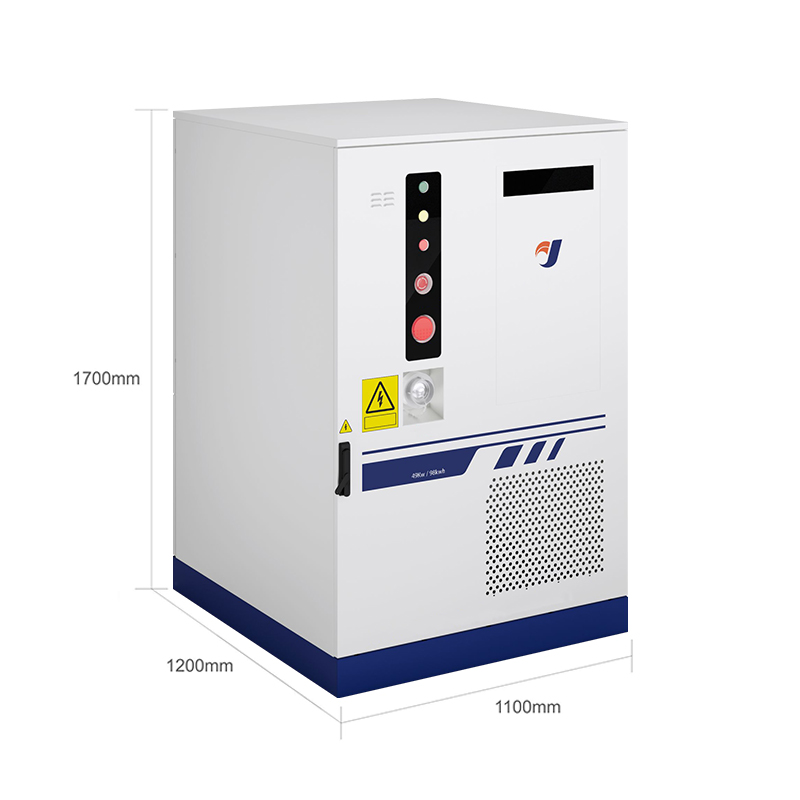 Liquid Cooling 49 kW Energy Storage CabinetIts integrated 98 kWh liquid-cooled design suits space-constrained sites, but wind-exposed installations still need corrosion, mounting and vibration details verified before purchase.View Product →
Wind and Hybrid Sites Are the Hardest Duty Cycle
Storage paired with wind generation rarely runs a clean daily cycle. Output swings within minutes, the battery sits at partial state of charge for long stretches, and the enclosure is often exposed to vibration, salt air and wide temperature ranges. That combination punishes thin-gauge panels, single-layer coatings and cabinets designed for indoor switchrooms. Specify the corrosion class, mounting interface and vibration assumptions early, because retrofitting a base frame after delivery is expensive.
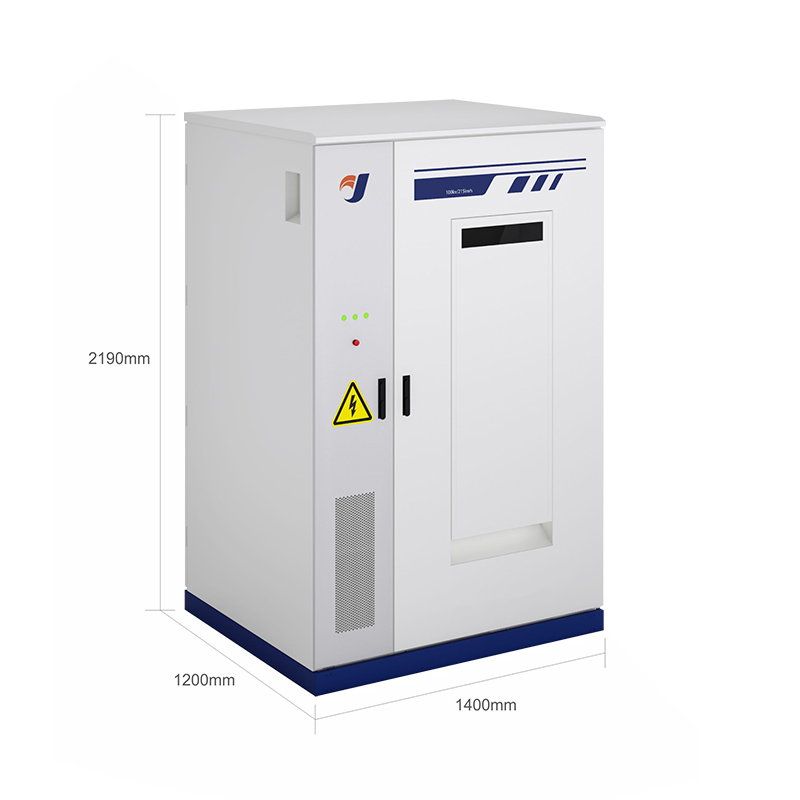 Air Cooling 100 kW Wind Energy Storage CabinetDesigned for wind power with 215 kWh capacity and air cooling, this plug-and-play cabinet is relevant before confirming building-side installation requirements.View Product →
Site Conditions Buyers Underestimate
Most installation delays trace back to the building, not the battery. Confirm these before the purchase order is signed:
- Floor loading. A 125 kW cabinet concentrates weight on a small footprint; a structural engineer should confirm the slab rating.
- Clearance. Door swing, ventilation clearance and cable bending radius are fixed by the enclosure drawing, not by convenience.
- Thermal path. A cabinet pushed against a wall or into a sun-exposed corner derates earlier than the same unit in open shade.
- Fire and detection. Local codes may require detection, suppression or separation distances that change the layout.
- Grid-connection testing. Witness tests, protection settings and anti-islanding checks take time; schedule them with the utility before delivery, not after.
What to Ask a Sheet Metal Manufacturer Before You Commit
Enclosure quality is verifiable. A supplier with an in-house fabrication line should be able to provide:
- Material certificates and gauge readings for the delivered panels.
- Coating thickness measurements and salt-spray reports.
- Weld inspection records and dimensional reports within the agreed tolerance.
- ISO 9001, ISO 14001 and ISO 45001 certificates, plus factory test reports per cabinet serial number.
- A stated position on coating wastewater and energy sourcing, which increasingly appear in tender documents.
A fabricator with four decades of metal forming experience, a 50,000 square metre facility and automated cutting, welding and coating lines can usually answer these quickly. Where the answers stay vague, assume the specification is loose and price the risk accordingly.
Custom Cabinets Versus Standard Enclosures
Standard cabinets win on price and lead time. Custom fabrication earns its cost in three situations: a tight pad or retrofit space where a few centimetres change the layout, a site that needs an integrated transformer bay or a different cable entry pattern, and projects with a specific finish or asset-tagging requirement. The engineering effort is front-loaded, but the alternative is often a longer site programme spent adapting a standard box. Buyers with repeat deployments usually negotiate custom sheet metal fabrication once and reuse the drawing across sites.
Cost, Lead Time and the Ordering Sequence
Budget conversations go wrong when the enclosure is treated as a rounding error. Steel, coating, thermal hardware and the labour to assemble them form a meaningful share of system cost, and they are the portion hardest to expedite. Cells and power conversion electronics are frequently stocked; a custom cabinet is not.
A practical sequence is: map the load profile, fix the power class, freeze the enclosure drawing and ingress rating, then order. Sites that reverse the last two steps spend the difference on site modifications and lost commissioning days.
Industrial power storage rewards buyers who treat it as a construction project with a battery inside. The chemistry is largely settled; the execution is not. Get the enclosure, the thermal path and the site conditions right, and the system will quietly do its job for a decade. Get them wrong, and no amount of cell quality will compensate.

Contact Us Now
News
LET’S BUILD YOUR CUSTOMIZED PRODUCT

Copyright ©Zhejiang Jiangnan Outdoor Products Co., Ltd.All rights reserved.
