


 English
 中文简体
1. Material Selection and Weather Resistance in Outdoor Furniture Choosing the right material is the...
READ MOREPeak Shaving Explained: Demand Charges, Battery Storage Sizing, Cabinet Design
Author: Admin
Date: Nov 12,2026
A plastics plant runs three injection moulders and a chiller bank. For most of the year the site draws around 380 kW. Then, on a hot July afternoon, the chillers and the second shift overlap for forty minutes and the demand meter records 610 kW. Under a tariff that bills the highest 15-minute average of the month — and, on many contracts, a ratchet that keeps that figure in play for the next eleven months — those forty minutes cost far more than the electricity they actually consumed.
Peak shaving is the practice of capping that spike so the recorded maximum stays below a chosen ceiling. The conclusion up front: for most commercial and industrial sites, trimming the top 10 to 15 percent of demand with a battery is technically simple and financially sound. What goes wrong is rarely the cell chemistry. It is sizing for power when the interval data called for energy, and then packing the system into an enclosure that loses its seals, its coating and its thermal headroom long before the battery loses capacity.
Content
- 1 What Peak Shaving Actually Cuts
- 2 Peak Shaving and Load Shifting Are Not the Same Project
- 3 Three Ways to Deliver the Reduction
- 4 Sizing: Power First, Then Energy
- 5 The Cabinet Is Part of the Specification
- 6 When the Site Also Generates
- 7 Reading the Numbers Before You Sign
- 8 A Short Procurement Checklist
What Peak Shaving Actually Cuts
Two numbers appear on a commercial bill and they are easy to confuse. Energy, in kilowatt-hours, reflects how much you used. Demand, in kilowatts, reflects how fast you used it — specifically the highest average over a metering interval of 15 or 30 minutes. Peak shaving attacks the second number only, and it does so by lowering the highest interval, not the total consumption.
The distinction matters because demand charges can account for a fifth to half of a commercial or light-industrial bill, and considerably more on sites with spiky loads: cold storage, water treatment, EV depots, extrusion lines, data halls, and any facility where a large motor starts while everything else is already running. Some tariffs add a ratchet clause, resetting billing demand to a percentage of the previous eleven months' highest peak, which turns one bad afternoon into a year-long penalty.
There is a third, less visible charge as well: connection capacity. A site that can hold its peak below an existing transformer rating can add a charger bank or a production line without paying for a grid upgrade. Peak shaving projects are frequently approved on that basis alone, before any energy saving is counted.
Peak Shaving and Load Shifting Are Not the Same Project
Both use the same battery, which is why they get conflated in sales conversations. They are sized by different numbers and they fail in different ways. Peak shaving buys kilowatts for a short window; load shifting buys kilowatt-hours across a price spread.
| Aspect | Peak shaving | Load shifting |
|---|---|---|
| What it changes | The maximum demand recorded in a metering interval | The time of day when energy is drawn from the grid |
| Typical duration | 30 minutes to 3 hours | 4 to 8 hours |
| Sizing driver | Inverter power, C-rate and cooling duty | Usable energy and cycle life |
| Revenue logic | Demand charge and capacity charge avoidance | Time-of-use price spread |
| Control requirement | Fast, forecast-driven, aligned to the billing interval | Schedule-based, predictable |
| Main risk | A rebound spike once state of charge runs out | Round-trip losses and cycle cost |
A system built purely for arbitrage may lack the C-rate and the control loop to catch a 15-minute spike. A power-heavy system sized for a short spike will cycle shallowly and leave most of its capacity idle for the rest of the day. Decide which job the asset is being paid for before anyone opens a datasheet.
Three Ways to Deliver the Reduction
- Load shedding. Non-essential loads are switched off or modulated during the peak interval. Response is immediate and capex is low, but production, comfort or charging throughput is interrupted, and the curtailment must be repeatable every month.
- On-site generation. A genset, fuel cell or gas engine carries the peak. Output is limited by ramp rate and start delay — typically 10 to 30 seconds for a diesel set — so it usually needs a short battery buffer to cover the gap.
- Battery storage. The fastest and quietest option, with inverters responding in well under a second. Depth and duration are limited only by the specified energy, and the same asset can trade flexibility or provide backup when it is not shaving.
Whatever the lever, the control layer decides whether the saving survives contact with reality. The controller must read demand on the same interval the utility bills on, forecast the remaining minutes of that interval, and hold a state-of-charge floor. A battery that empties at minute twelve of a fifteen-minute window does not shave the peak; it moves it to minute thirteen and can make the recorded maximum worse.
Sizing: Power First, Then Energy
The sequence below is the one that survives an audit. Skipping step two is the most common cause of underperforming systems.
- Pull twelve months of interval data at the utility's metering resolution, not monthly totals.
- Identify the maximum interval in each month and the shape of the peak: how fast it rises, how long it holds, how often it recurs.
- Set a demand ceiling that removes only the top slice of the peak. Shaving the last 5 percent of a very rare spike is disproportionately expensive.
- Multiply the target reduction by the required duration to get usable energy, then add depth-of-discharge, degradation and auxillary-load margins.
- Check the resulting C-rate against the inverter and pack specification, and confirm the cooling duty at that rate.
| Parameter | Worked value | Why it decides the design |
|---|---|---|
| Observed monthly peak | 640 kW | Baseline for the shaving target |
| Shaving target | 180 kW | Usually the top 10 to 25 percent, not the whole spike |
| Discharge duration | 90 minutes | Set by the load curve, not by habit |
| Usable energy | 270 kWh | Target power multiplied by duration |
| Depth-of-discharge margin | +12 percent | Packs are normally held near 90 percent usable |
| Degradation reserve | +8 percent | Capacity fade over a ten-year horizon |
| Specified capacity | 330 kWh | Rounded upward, never downward |
| Resulting C-rate | 0.55C | Drives inverter size and cooling duty |
The Cabinet Is Part of the Specification
Most buyers spend their diligence on cells and inverters, then accept whatever sheet metal arrives. That is a costly order of priorities. The enclosure carries the thermal path, the fire strategy and the corrosion barrier, and it is the part of the asset that cannot be upgraded later without lifting the whole system off its pad.
Three details separate a ten-year cabinet from a three-year one. First, thermal architecture: liquid-cooled systems hold cell temperature spread tighter than air-cooled designs, which extends cycle life on high-C-rate shaving duty, but the coolant loop still needs a correctly baffled sheet metal chassis and a serviceable manifold route. Second, sealing and corrosion: a coastal or industrial site wants an IP55 enclosure as a minimum, C4-grade coating systems, and gaskets that keep their compression rather than taking a permanent set — condensation, not rain, is usually what kills the electrics. Third, structural discipline: module rails held to within half a millimetre, doors that stay square after a hundred openings, welded frames that survive transport and seismic loading, and lifting points rated for a four to six tonne unit.
Fire strategy belongs in the same conversation: a defined venting path, detection at module level, and enough clearance for service access rather than a footprint crammed against a wall. Our energy storage cabinet range covers these points in the specification sheets rather than the marketing copy.
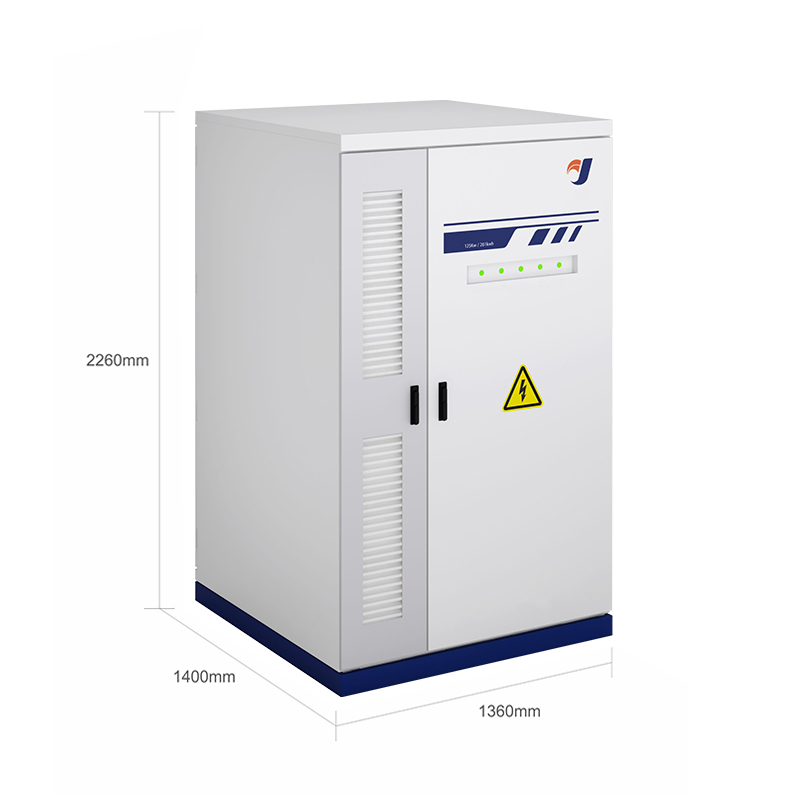 125 kW Liquid-Cooled Energy Storage CabinetLiquid-cooled 125 kW/261 kWh commercial cabinet with steel enclosure and modular layout, suited to larger sites weighing thermal management and service access.View Product →
Larger commercial sites often land on a liquid-cooled unit in the hundred-kilowatt class, where the cooling loop earns its cost back through slower capacity fade at sustained discharge rates.
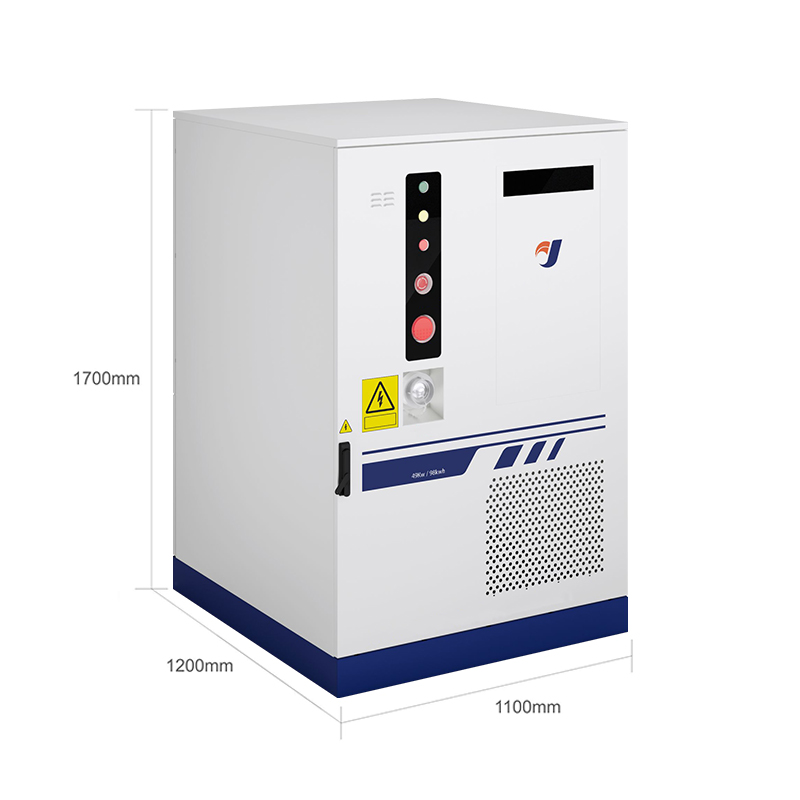 49 kW Compact Liquid-Cooled Energy Storage CabinetAll-in-one 49 kW/98 kWh liquid-cooled cabinet with integrated monitoring and scalable modules for space-constrained commercial and industrial sites.View Product →
Smaller facilities — a workshop, a cold room, a depot with a handful of chargers — typically need far less, and a compact liquid-cooled cabinet keeps the footprint and the transformer interface modest.
When the Site Also Generates
On a solar or wind site, peak shaving does a second job: it clips the export or import peak at the interconnection point, which may be the binding constraint on the whole project. A PV array that would otherwise exceed its connection limit at noon can be paired with storage that absorbs the excess and releases it later, and a wind-fed site can smooth short-term output swings in the same way. The sizing logic does not change — power first, energy second — but the duty cycle becomes more frequent, so round-trip efficiency and cycle rating move up the priority list.
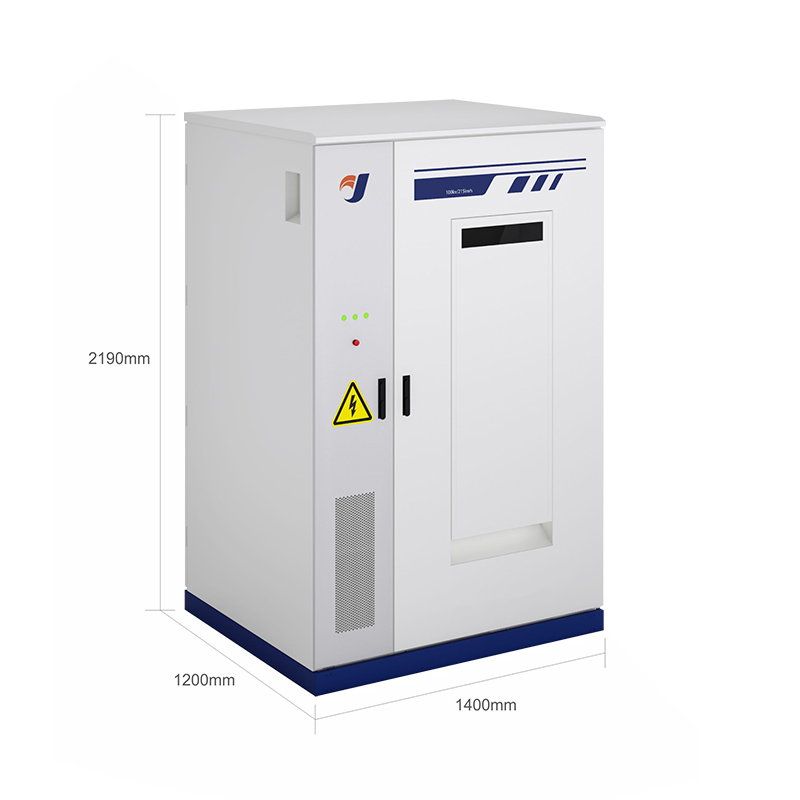 100 kW Air-Cooled Energy Storage CabinetAir-cooled 100 kW/215 kWh cabinet for wind sites, with integrated power management to smooth output and support hybrid or off-grid operation.View Product →
Reading the Numbers Before You Sign
Demand charges in the range of 10 to 25 currency units per kW per month are common across industrialised markets, and capacity charges can add a similar order of magnitude. On those figures, shaving 180 kW is worth roughly 1,800 to 4,500 per month, or 20,000 to 50,000 a year, before any arbitrage or flexibility revenue is added. Against a fully installed battery cost, that puts simple paybacks in the four-to-eight-year band for well-sized systems, and longer for badly sized ones.
The payback arithmetic improves further when non-energy value is counted: a deferred transformer upgrade, backup power for critical loads, reduced wear on chillers and compressors that no longer need to chase the peak, and eligibility for capacity or flexibility markets where they exist. Discount all of it properly — a peak shaving asset earns most of its money in a few hundred hours a year, and those hours are exactly the ones a warranty tends to exclude if the duty cycle was misdeclared.
A Short Procurement Checklist
- Interval data at billing resolution for at least twelve months, with the tariff structure attached.
- A written target: kW to be shaved, for how long, on how many days per year.
- Control narrative covering interval alignment, forecast logic, state-of-charge floor and rebound protection.
- Enclosure rating stated as a number, not an adjective: IP class, coating system, salt-spray hours, gasket material.
- Thermal performance at the actual duty cycle, not at a nominal 0.5C rating.
- Structural drawings showing foundation loads, lifting points, seismic bracing and service clearance.
- Factory acceptance test data for welds, coating thickness and dimensional tolerance.
- Warranty terms that match the duty cycle you intend to run, in writing.
Peak shaving is one of the few energy investments where the physics is settled and the financial case is legible. The variable part is execution: whether the system is sized from the load curve rather than a catalogue page, and whether the steel around it was built by someone who understands that a cabinet sitting outdoors for a decade is a thermal, sealing and corrosion problem long before it is an aesthetic one. A manufacturer with automated welding, laser cutting and an in-house coating line — and the environmental credentials to match, such as our green factory certification — will generally hold tolerances that a job shop quoting on price alone will not. Ask for the drawings, the test reports and the duty-cycle numbers, and the rest of the decision becomes arithmetic.

Contact Us Now
News
LET’S BUILD YOUR CUSTOMIZED PRODUCT

Copyright ©Zhejiang Jiangnan Outdoor Products Co., Ltd.All rights reserved.
