


 English
 中文简体
中文简体1. Material Selection and Weather Resistance in Outdoor Furniture Choosing the right material is the...
READ MORECommercial Energy Storage Systems: Selection, Safety and Cost-Saving Guide
Author: Admin
Date: Aug 17,2026
Content
- 1 Why Commercial Energy Storage Deserves a Place in Your Facility Plan
- 2 What a Commercial Energy Storage System Actually Does
- 3 The Business Case: Where the Savings Come From
- 4 Components That Determine Performance and Lifespan
- 5 Sizing the System to Your Load Profile
- 6 Safety, Standards, and Supplier Reliability
- 7 Final Considerations Before You Commit
Why Commercial Energy Storage Deserves a Place in Your Facility Plan
One 15-minute production spike can push your facility into a higher demand-charge tier and inflate the electricity bill for an entire month. That is the exact problem a commercial energy storage system solves. Instead of changing how your equipment runs, it changes when your facility pulls power from the grid.
The conclusion is straightforward: the value of commercial energy storage comes from timing. The system charges during low-price periods, typically at night or when renewable generation is abundant, and discharges during peak tariff windows or just before a demand spike would push your measured peak higher. The result is lower energy costs, better use of existing solar or wind capacity, and a buffer against grid disturbances, all without interrupting production.
For most buyers, the question is no longer whether battery storage works. It is which configuration, capacity, and supplier fits the site's load profile, budget, and safety requirements. This guide covers the fundamentals, the components that decide lifespan, and the selection criteria that separate a well-engineered system from an expensive mistake.
What a Commercial Energy Storage System Actually Does
A commercial energy storage system is a battery-based power unit scaled for facility loads, typically from tens to hundreds of kilowatts. It stores electricity in lithium-based battery modules and releases it on command through a power conversion stage. The core operating cycle is simple: charge when electricity is cheap, discharge when it is expensive, and stand ready as a backup source when the grid is unstable.
- Time-of-use arbitrage: charging during off-peak hours and discharging during peak tariff windows.
- Demand charge management: covering short but expensive load spikes so the facility's measured peak stays low.
- Backup and ride-through: keeping critical equipment online during outages and voltage sags.
- Renewable self-consumption: storing surplus solar or wind power instead of exporting it at low feed-in rates.
- Grid services: where local regulations allow, responding to frequency or capacity signals for additional revenue.
Most commercial systems now use lithium iron phosphate (LiFePO4) chemistry, which combines long cycle life with stable thermal behavior. That combination is the main reason LiFePO4 dominates the commercial segment.
The Business Case: Where the Savings Come From
Storage economics rarely depend on a single mechanism. Most successful projects earn their return through a combination of the streams below.
Peak Shaving and Demand Charge Reduction
Demand charges often represent 30 to 50 percent of a commercial electricity bill, depending on the utility and tariff. Storage attacks that line item directly. A facility that shaves 100 kW from its monthly peak at a demand rate of $12 per kW saves $1,200 per month before energy arbitrage is even included. Over a ten-year system life, that single action can return more than the hardware cost.
Backup Power and Operational Resilience
When grid faults cause production losses, the ability to ride through is worth more than any energy arbitrage. Battery systems respond in milliseconds, switch to island mode without dropping loads, and, unlike diesel generators, need no fuel supply or frequent load testing. That makes them attractive for cold storage, data centers, healthcare facilities, and manufacturing lines where an interruption is measured in thousands of dollars per minute.
Renewable Integration and Sustainability Goals
Facilities with rooftop solar or access to wind power can capture surplus generation that would otherwise be exported at low feed-in rates. The storage system time-shifts that energy to match on-site demand. Beyond direct economics, the same project strengthens corporate sustainability reporting. That claim is more credible when the supplier itself operates a certified green factory, because the same lifecycle discipline carries into the products.
Components That Determine Performance and Lifespan
Price per kilowatt-hour is the easiest number to compare and the least useful. Four hardware areas decide whether a system still performs in year eight.
Battery Chemistry and Cell Quality
LiFePO4 cells are the right default for commercial applications because they tolerate higher temperatures, show lower thermal runaway risk than nickel-based chemistries, and typically deliver 6,000 to 10,000 cycles at 80 percent depth of discharge. Check the conditions on the datasheet: cycle life figures assume controlled temperatures and specific charge and discharge profiles. A system operated outside those conditions will not reach its stated numbers.
Battery Management System
The BMS monitors cell voltage, temperature, and state of charge, balances cells, and protects against overcharge, over-discharge, and overheating. It also communicates with the inverter so the system can ramp up and down safely. Insist on cell-level monitoring rather than module-level only; that is the difference between catching a failing cell early and losing an entire string.
Power Conversion System
The PCS converts DC battery power to grid-compatible AC, controls charging and discharging, and manages the transition to backup mode. Round-trip efficiency, partial-load performance, and the speed of the transfer switch matter more than the nameplate rating. For backup use, confirm the PCS supports seamless islanding so critical loads do not experience even a brief dropout.
Thermal Management and Enclosure Quality
Temperature is the biggest driver of battery aging. Air cooling is simpler and cheaper, but liquid cooling keeps cell temperatures uniform, extends cycle life, improves power density, and reduces the indoor space required. Enclosure quality is equally important. The cabinet is also a metal structure: welded frames, corrosion-resistant paint, sealed doors, secure cable routing, and fire-resistant compartments. This is where sheet metal fabrication experience shows up, and it is the part of the asset that is hardest to retrofit after installation.
Sizing the System to Your Load Profile
Sizing starts with a year of interval data, ideally at 15-minute resolution. The power rating determines how much load can be covered at any moment, and the energy capacity determines how long the system can sustain that coverage. The ratio between the two, expressed as the C-rate, is what makes a configuration suitable for peak shaving, backup, or renewable firming. High-level comparisons of common commercial configurations look like this:
| Configuration | Rated Power | Key Characteristic | Typical Application |
|---|---|---|---|
49 kW liquid-cooled energy storage system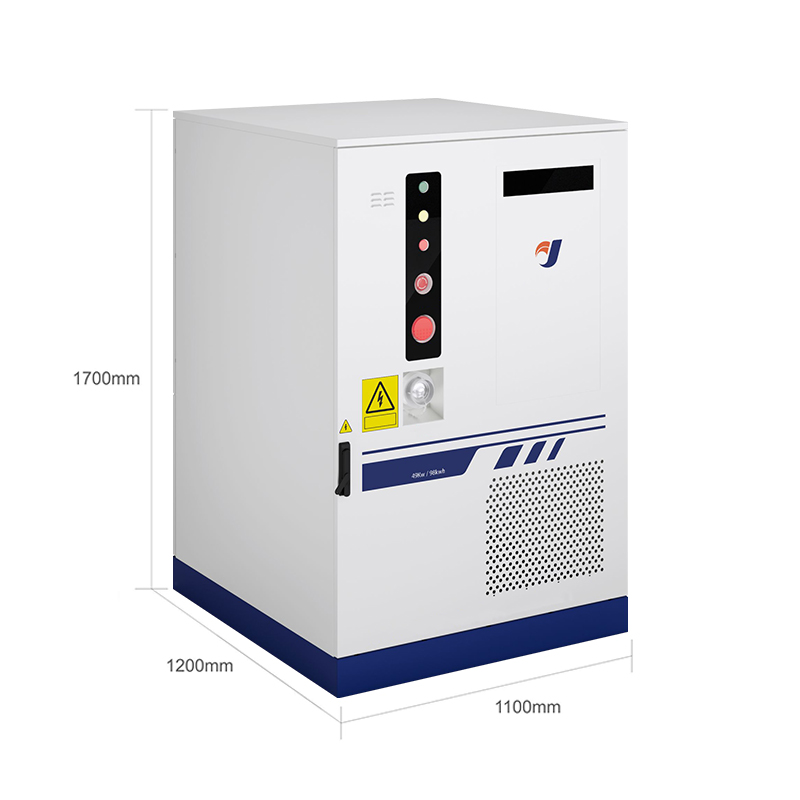 Energy Storage CabinetEnergy Storage Cabin...View Product → Energy Storage CabinetEnergy Storage Cabin...View Product → |
49 kW | Liquid cooling for uniform cell temperature and a compact footprint | Retail centers, small factories, office buildings |
125 kW liquid energy storage system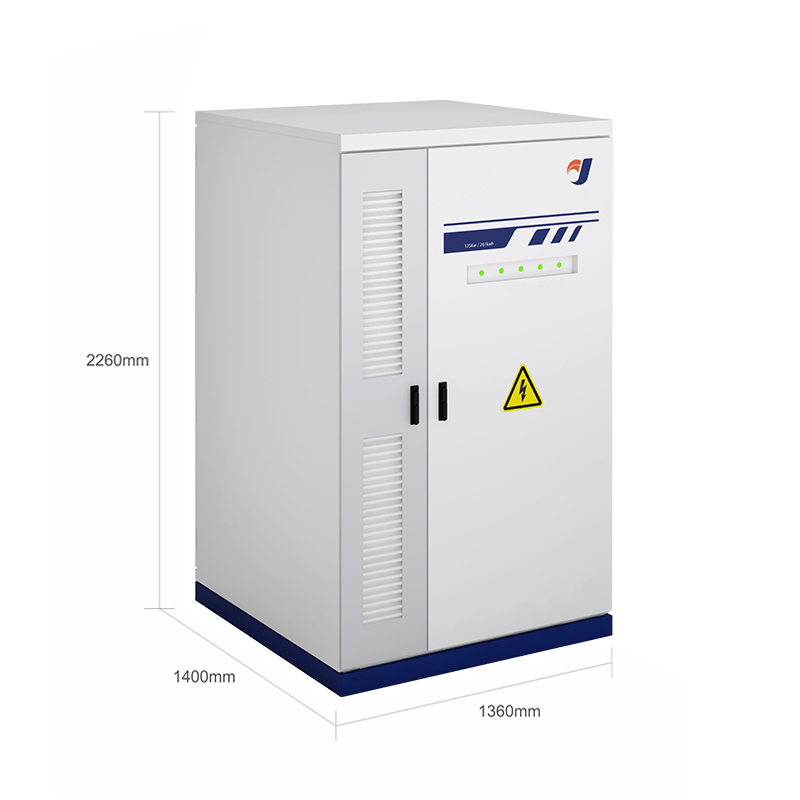 Energy Storage CabinetEnergy Storage Cabin...View Product → Energy Storage CabinetEnergy Storage Cabin...View Product → |
125 kW | Higher power rating for intensive commercial loads | Manufacturing plants, logistics parks, larger commercial campuses |
100 kW wind energy storage system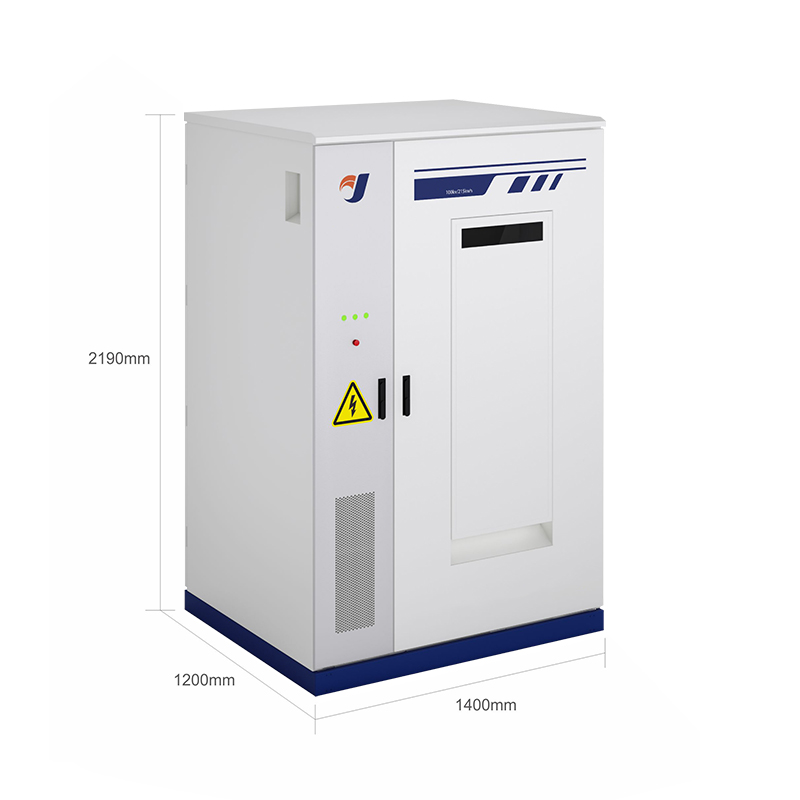 Energy Storage CabinetEnergy Storage Cabin...View Product → Energy Storage CabinetEnergy Storage Cabin...View Product → |
100 kW | Built for pairing with wind generation | Wind farms, hybrid renewable projects, remote industrial sites |
For a site with moderate peaks, a 49 kW liquid-cooled unit often covers the most frequent spike events without oversizing. A 125 kW system suits larger loads or operations that want to shave deeper peaks while keeping reserve capacity. Wind-integrated storage follows a different logic: it smooths variability on the generation side rather than the facility side, so it fits hybrid renewable projects and remote industrial sites best.
Two practical warnings. Oversizing is the most common procurement error: it extends the payback period and leaves batteries under-used. Undersizing ignores the risk that a new production line or rising tariff penalties will require a second cabinet. Choose a modular range that can grow, and document the expansion path before you sign.
Safety, Standards, and Supplier Reliability
Safety is not a single feature; it is the sum of cell chemistry, BMS protection levels, thermal management, enclosure design, and installation quality. When evaluating a system, ask for the relevant test documentation: IEC 62619 for cell safety, UL 9540A for thermal runaway propagation, and the grid connection standard that applies to your site. Also examine manufacturing quality management. An ISO 9001, ISO 14001 and ISO 45001 certified factory has verifiable quality control, environmental management, and occupational safety systems, which lowers the risk of defects surfacing after commissioning.
The enclosure is part of the safety argument. A battery cabinet without proper sealing can let in rain, salt, dust, or condensation. A cabinet with weak welds can deform during transport or lifting. A coating system that fails early means corrosion and premature maintenance. These are sheet metal problems, not battery problems, and they are worth investigating before purchase. Reviewing the full energy storage cabinet range from a manufacturer with a long metalworking history shows how seriously the physical structure is engineered.
Final Considerations Before You Commit
Before signing a purchase agreement, verify five things:
- Your load data: use at least 12 months of interval reads and identify the frequency, duration, and timing of peak events.
- Your tariff structure: confirm the demand charge, time-of-use windows, and any utility interconnection requirements.
- The expansion path: confirm the system accepts additional modules or cabinets without replacing the core electronics.
- The warranty terms: check the guaranteed throughput or calendar life and the conditions that void coverage.
- The documentation: request datasheets, certificates, test reports, and a proposed maintenance schedule before ordering.
Commercial energy storage is not a one-size-fits-all product. A properly sized, well-built system pays for itself through demand charge savings, energy arbitrage, and avoided downtime; a poorly matched one turns into a maintenance liability. Start with the data, match power and energy to the load profile, and choose a supplier whose manufacturing depth matches the promise of the battery cells. Done that way, storage becomes one of the most predictable investments a facility can make.

Contact Us Now
News
LET’S BUILD YOUR CUSTOMIZED PRODUCT

Copyright ©Zhejiang Jiangnan Outdoor Products Co., Ltd.All rights reserved.
